
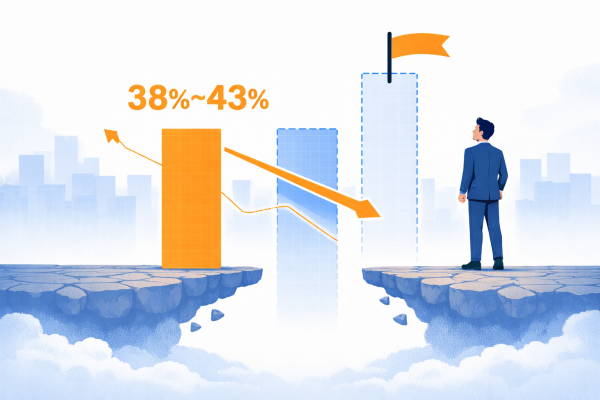
The numbers are in, and while the market may have stabilized, performance has not rebounded.
According to recent benchmarks from RepVue, Everstage, and Salesforce, quota attainment has settled into a lower “new normal,” well below the highs of 2021. Across roles, fewer than half of sellers are consistently hitting their targets.
This is not a temporary dip. It is a structural shift.
And it raises an important question: Why are so many go-to-market teams still missing quota, despite more tools, more data, and now, more AI than ever before?
The Reality Check: A Performance Problem Across the Board
The data tells a clear story:
- Enterprise AEs: 38%–43% attainment, recovering slightly from a 2024 low.
- Mid-Market AEs: 40%–45%, highly dependent on deal size.
- SDRs/BDRs: 53%–68%, but facing significant burnout and turnover.
- Top 20% of reps: 120%+, reinforcing a strong “power law” dynamic.
Performance is not just down, it is uneven. A small percentage of sellers are thriving, while the majority struggle to consistently deliver. That gap is where the real story lies.
The Usual Explanations, And Why They Are Not Enough
It is easy to point to external factors:
- Buyers are more cautious.
- Sales cycles are longer.
- Budgets are tighter.
- Competition is increasing.
All true. But also incomplete. Because these conditions affect everyone, yet the top 20% still significantly outperform. That suggests the issue is not just the market, it is how teams are engaging within it.
AI Is Entering the Picture, But It Is Not Moving the Needle (Yet)
Many organizations are now turning to AI to improve performance:
- Automating outreach.
- Generating messaging.
- Enhancing forecasting.
- Providing deal insights.
And these investments are absolutely worth making.
But here is the reality: AI is amplifying activity, not necessarily improving outcomes.
Without the right foundation, AI can:
- Scale generic messaging instead of differentiated value.
- Increase volume without improving conversion.
- Accelerate processes that were not effective to begin with.
AI does not fix a broken value approach. It scales whatever you give it. Which means the core issue still remains.
The Deeper Problem: A Value Gap in the GTM Motion
If you look closely, a pattern emerges across struggling teams:
Value is not being consistently defined, communicated, or delivered in a way buyers can act on.
This shows up in several ways:
- Value is introduced too late – Often during pricing or justification, not when the problem is being defined
- The role of value is reactive – Similar to how Value Engineers are engaged today, brought in to support deals rather than shape them.
- Value is inconsistent across roles – SDRs generate interest, AEs pitch solutions, and value teams operate in silos.
- Too much focus on activity, not impact – Pipeline volume, meeting counts, and outreach metrics overshadow meaningful business conversations.
- Buyers cannot justify the decision internally – Deals stall not due to lack of interest, but lack of clear, defensible outcomes.
This is not a sales execution issue alone. It is a value communication, quantification and alignment issue.
Why the Top 20% Continue to Win
The highest performers operate differently. They are not just better at selling. They are better at making value emotional AND tangible.
They:
- Reveal and amplify pain and the cost of “do nothing”.
- Anchor conversations in business outcomes early.
- Quantify impact in ways that are simple and credible.
- Combine analytics with storytelling to make the case compelling.
- Align multiple stakeholders around a shared vision of success.
In many ways, they are already behaving like what we might call Value Experts.
The Shift Required: From Selling Products to Architecting Outcomes
To close the gap, organizations need to evolve their go-to-market approach:
- From product-led conversations → to value-led engagements.
- From late-stage ROI → to early and continuous value definition.
- From siloed roles → to aligned, cross-functional value delivery.
This is not a small adjustment. It is a shift in how value is created, communicated and quantified across the entire customer journey.
The Missing Capability: The Rise of the Value Expert
This is where a new capability begins to emerge. Not just a seller. Not just a Value Engineer.
But a Value Expert who:
- Engages early to help define the problem and the business impact of “do nothing”.
- Quantifies value, but also shapes the narrative around it.
- Works across sales, marketing, and customer success.
- Ensures value is not just promised, but realized through renewal and expansion.
This role is not about adding headcount. It is about building a capability that most organizations currently lack or underutilize.
What Actually Moves the Needle
If quota attainment is going to improve, the focus needs to shift:
- Move value upstream – Bring business impact into the very first conversation.
- Standardize value communication – Equip every role with a shared framework, not just specialized teams.
- Invest in value storytelling as much as tools – Numbers alone do not persuade, context and narrative do.
- Embed value across the customer lifecycle – From pre-sales through adoption, renewal, and expansion.
- Enable AI with better inputs – Strong value messaging, clear use cases, and structured business value quantification and capability / maturity frameworks make AI more effective.
AI can accelerate this, but only if the underlying value foundation is strong.
The Bottom-Line: Is This a Sales Problem, Or a Value Problem?
Low quota attainment is often framed as a sales execution issue. But the evidence suggests something deeper.
In a market where buyers demand clear outcomes and strong justification, success depends on how well organizations can define, communicate, and deliver value.
So the real question becomes: Do we need better sellers… or do we need to build value expertise at scale?
Because until that gap is addressed, no amount of tools, technology, or AI will fully close this troublesome quota attainment gap.
Let’s discuss your sales quota shortfalls and how Value-Led Growth can help to drive attainment and consistency: Click here to schedule a consultation with us.