
Insights

Our latest thinking on the issues that matter most in value enablement, management, and consulting.
AI ROI Reckoning
Best Practices

The AI ROI Reckoning: Why Outcome Pricing Is About to Expose Your Value Practice (or Lack Thereof)

Two years of AI investment, and the bill is coming due. The spending is not slowing. The proof is not arriving. And a handful of the largest AI providers have just started doing something that should make every revenue leader sit up: they are offering to get paid only when the work actually gets done.

That is not a pricing experiment. It is a transfer of risk. And most go-to-market organizations are not instrumented to survive it.

Read More »
Build it Ourselves
Best Practices

Yes, You Could Build It Yourself, But Should You?

With AI, you probably can build the value program yourself, which is why arguing the capability question is both wrong and unpersuasive. The questions that actually decide the outcome are whether it sits on a validated foundation, whether the six months you scoped becomes nine or twelve, and what the revenue you were going to earn in the meantime was worth.

Read More »
8 in 10 sales leaders
Best Practices

The Value Gap Is Now the Growth Gap: What Gartner’s 2026 CSO Research Means for Value-Led Growth Leaders

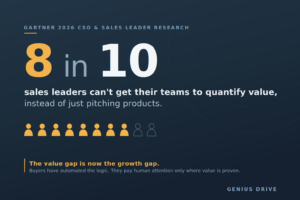
At the 2026 Gartner CSO conference, nearly 8 in 10 sales leaders said their top concern was getting sellers to quantify value instead of pitching products, and the wider research explains why it has become existential: buyers now automate the logic with AI and reserve their scarce human attention for proof of value. The value gap and the growth gap have become the same gap, and closing it is no longer a training project but a structural mandate for every revenue leader.

Read More »
Four measures for Outcome Maxxing
Best Practices

From Vanity Metrics to Realized Value: A Value Leaders Guide to Outcome Maxxing

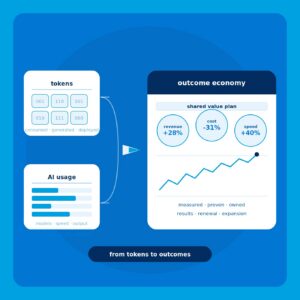
Enterprise software is drifting into a dangerous cycle where buyers and vendors optimize for activity metrics like token consumption, utilization, and renewals, while the actual business outcomes behind the investment remain poorly measured and undervalued.

As AI accelerates the shift toward consumption-based pricing, companies are discovering that maximizing usage does not guarantee maximizing impact, fueling the need for a new model centered on realized business value: Outcome Maxxing.

Read More »
Outcome Architect
Best Practices

Do We Need to Rename the Value Engineer… to Outcome Consultant / Architect?

For years, the role of the Value Engineer or Value Consultant has been a cornerstone of modern go-to-market teams. Helping quantify ROI, build business cases, and justify decisions has become essential in complex B2B sales.

But as the market shifts toward an Outcome Economy, it raises an important question: Is the role itself evolving beyond its name?

Read More »
Software Outlook
Best Practices

From Features to Outcomes: What Deloitte’s Software Industry Outlook Signals About the Outcome Economy

The software industry is entering another period of transformation. According to Deloitte’s 2026 Software Industry Outlook, financial pressure, AI-first products, and new competitors are reshaping how software companies operate and compete.

But beneath these technology trends is a deeper shift that every go-to-market leader should understand: The market is moving toward an Outcome Economy.

Read More »
Sales Quota Shortfall
Best Practices

Why Sales Quota Shortfalls Remain, And What Needs to Change

According to recent benchmarks, quota attainment has settled into a lower “new normal,” well below the highs of 2021. Across roles, fewer than half of sellers are consistently hitting their targets. This is not a temporary dip. It is a structural shift.

And it raises an important question: Why are so many go-to-market teams still missing quota, despite more tools, more data, and now, more AI than ever before?

Read More »
Value Expert Five Belts
Best Practices

The Value Gap in B2B Sales, and Why Training May Be the Most Underrated Growth Lever

Despite years of emphasis on value selling, fewer than one in five sellers consistently apply it in customer conversations. Closing this adoption gap through structured training and practice may be one of the most effective ways for B2B organizations to drive revenue growth.

CFOs are no longer passive approvers at the end of the sales cycle. They are active architects of enterprise strategy, capital allocation, and value realization.

Read More »