
For more than a decade, B2B organizations have emphasized the importance of value-based selling. Most revenue leaders agree that sales teams must move beyond product features and price to focus on business outcomes.
The strategy is widely accepted.
Execution, however, tells a different story.
Across many organizations, fewer than one in five sellers consistently engage customers in value-based conversations. Adoption across customer success teams is often even lower, despite the critical role value realization plays in renewals and expansion.
This gap between strategy and behavior may be one of the largest untapped opportunities in modern go-to-market organizations.
Because when adoption increases, revenue performance tends to increase alongside it.
Many organizations that measure value-selling adoption find a striking pattern.
Every 10% increase in adoption of value-based engagement practices can translate into roughly a 10% improvement in revenue performance, driven by improvements in win rates, deal sizes, and retention.
Viewed through that lens, value activation may be one of the most efficient investments a revenue organization can make.
After all, how many other go-to-market initiatives can realistically deliver 10% revenue growth with a relatively modest investment in capability development?
The Buying Environment Has Changed
The urgency around value conversations is not theoretical. It reflects a fundamental shift in how organizations buy technology.
B2B buying has become dramatically more complex. Research from Gartner suggests the average B2B purchase now involves 6 to 10 stakeholders, each bringing their own priorities, data requirements, and risk concerns into the process. In this environment, vendors must do more than explain their product. They must help buyers align around the business value of a decision.
As a result, the number of deals that simply stall or disappear has increased significantly.
Research shows that more than half of buying efforts now end without a decision. Even when deals do close, they often require price concessions, with over 20% of deals relying on discounts to reach agreement. And the challenges extend beyond the initial purchase. More than two-thirds of buyers report experiencing purchase regret shortly after signing, a dynamic that contributes to declining retention and weaker renewals.
These trends create real pressure for revenue teams. Sales cycles lengthen. Discounting increases. Expansion becomes harder. And renewal conversations become more uncertain.
In many cases, the challenge is not the product itself. Instead, it is the ability to clearly articulate why the solution matters and how it will impact the business.
Buyers consistently report that they value vendors who understand their business, collaborate on outcomes, and help them build confidence in the decision they are about to make. These expectations sit squarely at the center of value-based engagement.
If Value Selling Is So Important, Why Is Adoption Still So Low?
The challenge is not awareness. Most sellers understand the concept of value selling.
The real challenge is behavioral change.
Many organizations introduce value frameworks, ROI calculators, or messaging around outcomes. But introducing a framework rarely changes behavior on its own. Under pressure, sellers often revert to familiar territory, focusing on product capabilities, differentiation, and pricing.
Value engagement requires a different set of skills.
It requires the ability to understand business challenges, translate technology into financial impact, and communicate outcomes with credibility to executive stakeholders.
In other words, it requires both art and science.
The science includes financial modeling, ROI analysis, and business case development. The art involves discovery, storytelling, and the ability to guide buyers toward a shared vision of success.
Developing these capabilities takes more than a one-time training session.
The Practice Problem
Behavioral research consistently shows that skills do not stick without repetition.
Studies in learning science and deliberate practice suggest that meaningful skill adoption often requires dozens of repetitions before behaviors become natural, with some training methodologies indicating 40 to 50 practice cycles may be necessary for new professional skills to become ingrained. Research from the National Training Laboratories has similarly demonstrated that active practice and teaching others can increase knowledge retention to 70–90%, compared to roughly 5–20% retention from passive learning formats such as lectures or reading alone.
This presents a challenge for revenue organizations: Where do those repetitions happen?
Historically, organizations relied on two approaches.
The first is live customer interactions. Sellers learn by doing, refining their approach over time. But this means practicing on real deals, often high-value opportunities where mistakes can be costly.
The second approach is manager coaching. Coaching can be extremely effective, and organizations that implement consistent sales coaching have been shown to improve win rates by as much as 20% or more, according to research from CSO Insights. But coaching is difficult to scale consistently across large teams, especially when managers themselves may not be experts in value engagement.
Neither approach alone provides the volume of practice required to build deep capability.
This is one reason adoption remains stubbornly low.
Professionals may understand the theory of value selling, but they rarely receive enough structured practice to build confidence.
And without confidence, most people avoid the conversation entirely.
A New Approach to Capability Development
Modern enablement programs are beginning to rethink how value skills are developed.
Instead of relying on large, one-time workshops, many organizations are moving toward self-paced, modular learning environments that allow professionals to build capability progressively.
Short learning modules help reinforce concepts without overwhelming participants. Knowledge validation through quizzes and exercises ensures learners are actually internalizing the material. Practical workbooks and guides provide structured frameworks that can be applied directly in customer engagements.
But perhaps the most significant shift is the emergence of AI-driven role-play environments.
These environments allow sellers and customer success professionals to simulate real-world customer conversations in a safe environment. Participants can practice discovery, articulate business value, respond to objections, and refine their storytelling before ever engaging a real buyer.
Instead of practicing on critical deals, professionals can practice dozens of times in realistic scenarios.
In effect, AI creates the repetition environment that traditional training has always struggled to provide.
And repetition is what turns knowledge into capability.
One of the Highest ROI Investments in Go-To-Market
For revenue leaders evaluating where to invest in growth, the adoption gap in value engagement presents a compelling opportunity.
If fewer than 20% of sellers consistently apply value-based practices today, even modest improvements in adoption can have meaningful impact.
Increasing adoption by 10% may produce roughly 10% improvements in revenue performance, making value enablement one of the most leveraged investments available to go-to-market organizations.
Yet compared to investments in demand generation, technology platforms, or pricing strategies, structured capability development often receives far less attention.
That may be beginning to change.
McKinsey research has shown that organizations that invest systematically in capability building can achieve up to 20–30% improvements in performance outcomes across sales, operations, and leadership functions.
As the buying environment becomes more complex and financially driven, organizations are recognizing that value conversations are not simply a messaging challenge.
They are a capability challenge. And capabilities must be built.
Closing the Value Gap with Training & Certification
The organizations that succeed in the coming decade will likely be those that help buyers answer three critical questions:
- Is this problem important enough to solve?
- What is the business value of solving it?
- And how confident can we be in the outcome?
Answering those questions requires more than product expertise. It requires professionals who can translate technology into measurable outcomes and communicate that impact with credibility.
Closing the gap between value strategy and real-world execution is not easy. But it may be one of the most powerful levers available for improving revenue performance.
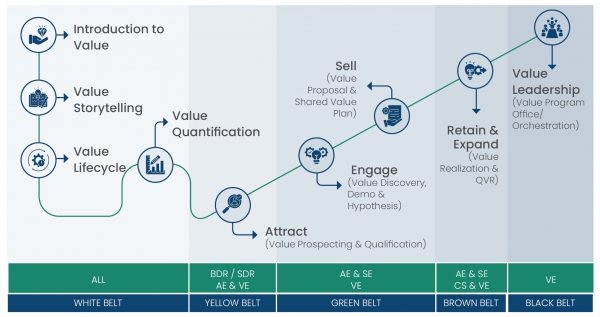
For organizations looking to build these capabilities across sales, presales, and customer success teams, structured programs like the Value Expert™ certification are designed to provide the frameworks, practice environments, and practical tools needed to make value engagement a repeatable skill rather than an occasional success.
Because in an environment where adoption remains below 20%, the opportunity to improve is still enormous.
Learn more about Value Expert E-Learning and Certification, with modules personalized to elevate value communication and quantification skills and capabilities for every member of your GTM team: https://geniusdrive.com/enablement-training/
Let’s discuss your value gap and training needs: Click here to schedule a consultation with us.