
The one number every CSO should sit with
At the 2026 Gartner CSO & Sales Leader Conference, David Yockelson, Research Vice President and Gartner Fellow, shared an observation that should stop every revenue leader in their tracks.
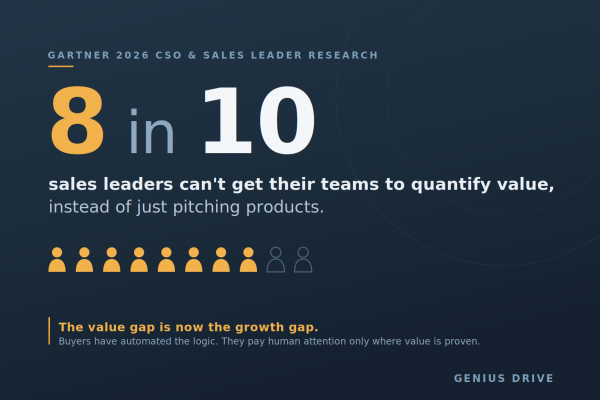
Of the ten sales leaders he met with at the event, nearly all of them wanted to know: “how do we get our sellers to speak to customer needs and solutions vs. our products and their features.” That’s about 8 out of 10 concerned with their teams’ ability to transition from pitching products, to clearly communicating and quantifying value.
Sit with that ratio for a moment. Not 8 in 10 who wanted better AI tooling. Not 8 in 10 worried about pipeline coverage or forecast accuracy. Eight in ten worried about the single capability that sits at the center of every deal, every renewal, and every expansion: the ability to prove, in the buyer’s terms, that the challenge is a priority and the outcome is worth the investment.
Yockelson is a useful voice here because value management and value realization sit squarely inside his research coverage. When the analyst who studies value for a living tells you that the leaders he speaks with cannot reliably do it, that is not a training gap. That is a structural gap in the commercial engine.
And the rest of Gartner’s 2026 CSO research from the event explains exactly why it has become the defining challenge of the year.
Gartner’s own agenda put “the value gap” at the center
The value articulation problem was not a hallway conversation. It was a headline theme of the conference itself.
One of the flagship sessions was built around a blunt warning: sales organizations that cling to a supplier-centric view of value, rather than aligning to the buyer’s definition of it, risk declining pipeline, stalled deals, and slower growth. The prescribed fix was to realign value propositions to customer priorities, close the value gap, and help sellers regain influence with buyers.
Read that as a value practitioner and the diagnosis is familiar. Most “value” content is still built from the inside out. It leads with the product, the platform, the feature list, and the vendor’s sense of what matters. The buyer is standing somewhere else entirely, asking a different question: what changes for me, by how much, and how confident can I be in that number? The gap between those two vantage points is the value gap, and Gartner is now naming it as a direct driver of stalled revenue.
Why 2026 is the year this becomes existential
Three forces in the same body of research turn a long-standing weakness into an urgent one.
1. Buyers have split their brains between AI and humans
Gartner’s research describes a buyer journey that has effectively split in two. Buyers increasingly delegate the cold, factual evaluation of a purchase to AI, and they reserve human interaction for trust and validation. In Gartner’s framing, buyers are outsourcing the logic and craving the connection at the same time.
The data underneath this is striking. Around 67% of B2B buyers now say they prefer a rep-free experience for much of their journey, yet 69% still turn to a sales rep to validate the insights that AI has generated for them. Gartner’s analysts captured the implication precisely: the seller’s role is shifting from persuader to verifier.
Think about what that does to the value conversation. When a buyer arrives already armed with an AI-assembled view of the market, generic capability pitches are worthless, because the buyer has already read them faster than any rep could deliver them. What the buyer cannot get from a model is a credible, defensible, buyer-specific quantification of outcome and risk, validated by someone who has done it before. Value articulation is no longer one seller skill among many. In a verifier role, it is close to the whole job.
2. Buyers now actively punish generic outreach
The same research found that 73% of buyers avoid suppliers who send irrelevant messaging. The old pipeline reflex, more touches and more activity, is now training buyers to opt out. Volume without relevance is not neutral anymore, it is corrosive. The only messaging that survives that filter is messaging anchored in the buyer’s own outcomes, priorities, and economics, which again returns to the discipline of value.
3. Growth is supposed to come from customers you already have
Gartner reports that CSOs expect around 65% of growth to come from existing customers, while acknowledging that the account management role is not yet set up to capture it. This is the quiet bombshell for anyone who thinks of value as a top-of-funnel selling tactic. If two-thirds of your growth depends on retention and expansion, then value cannot be a one-time pitch delivered before the signature. It has to become an ongoing capability that proves realized value across the entire customer lifecycle, precisely where renewals and expansions are won or lost.
The AI ROI mirror: CSOs face the exact problem they create for buyers
Here is the irony that gives this year’s research its edge. While CSOs worry that their sellers cannot quantify value for buyers, they are struggling to quantify the value of their own AI investments.
Gartner found that 31% of CSOs cite difficulty proving the ROI of AI-driven tools as a top challenge for their 2026 objectives. It also found that AI is already saving sellers close to 5 hours per week, yet 72% of sales organizations fail to reinvest that reclaimed time into high-value activities.
And in a finding that should sting, roughly 70% of CSOs are held accountable for driving AI ROI inside the sales org, while only about 13% of CEOs believe their CSO is strongly AI-savvy.
The lesson practically writes itself. The value realization discipline that CSOs need their sellers to bring to buyers is the same discipline they need to apply to their own technology bets. You cannot credibly ask a team to quantify outcomes for customers if you have no rigorous way to quantify the outcomes of the tools you hand them. Value-Led Growth is not only an external selling motion. It is an internal operating standard.
There is even a reward signal in the data for getting the AI motion right. Gartner found that sales organizations providing AI-enabled next best actions were about 2.6 times more likely to achieve commercial growth. The winners are not the ones with the most AI activity. They are the ones translating AI activity into measurable outcomes, which is the entire premise of the shift from activity metrics to the outcome economy.
What this means for Value-Led Growth CSOs
If you lead sales, enablement, or revenue and you have built your strategy around value, this research is validation, but it is the kind of validation that comes with a to-do list. Five moves follow directly from the findings.
Turn value articulation into a repeatable capability, not a talent lottery
The reason 8 in 10 leaders are worried is that value articulation in most organizations lives in the heads of a handful of top performers. It is a talent lottery, and it does not scale. The fix is to make it a system: a consistent methodology, quantified value models, and value tools that any competent seller can execute, not just the naturals. A structured value narrative built around Pain, Impact, Vision, Outcome, and Trust gives every rep the same credible path from the buyer’s problem to a defensible number, so credibility stops depending on who happens to be in the room.
Rebuild your value story from the buyer’s priorities, not your product
Gartner’s warning about the supplier-centric value view is a warning against the way most decks are still built. Start from the buyer’s strategic priorities, their pains, and their metrics, then map capability to those. The hero of the story is the customer and the outcome they are trying to reach, not the platform. When the value story is framed around the buyer’s world, it clears the relevance filter that 73% of buyers now use to screen suppliers out.
Equip sellers to win the verifier moment
If buyers now reserve human interaction for trust and validation, then every seller conversation is a verification event. That raises the bar on evidence. Sellers need quantified, benchmarked, buyer-specific value cases they can defend under scrutiny, not glossy assertions. This is where trust, the final element of a strong value narrative, does the heavy lifting: proof points, references, ranges, and honest treatment of risk. A seller who can validate and pressure-test a buyer’s own assumptions is worth meeting. A seller who only repeats the brochure is exactly the rep those buyers are trying to avoid.
Extend value from the deal to the lifecycle with a shared value plan
Because most growth is expected from existing customers, value has to keep being proven after the sale. That means establishing, at the point of purchase, an agreed baseline and a set of target outcomes, then returning to measure realized value on a regular cadence. Treat this shared value plan as a living commercial artifact, jointly owned with the customer, that documents what was promised, what was delivered, and what expansion the realized value now justifies. Value realization becomes the connective tissue between the sale, the renewal, and the next expansion, rather than a claim that evaporates once the contract is signed.
Prove your own AI ROI with the same rigor you demand externally
Apply your value methodology inward. Define the outcomes you expect from each AI investment, baseline them, and measure realized impact, including whether that reclaimed 5 hours per week is actually being redeployed into high-value selling. Doing this closes the credibility gap that 87% of CEOs apparently perceive in their CSOs on AI, and it models the exact behavior you want your sellers to bring to buyers. Outcome discipline is the same skill whether the customer is external or internal.
The Bottom Line: Quantified Value + Trust
Strip away the AI headlines and the 2026 Gartner CSO research tells one coherent story. Buyers have automated the logic and now spend their scarce human attention only where trust and quantified value are on the table. Generic activity is being filtered out, growth increasingly depends on proving value to customers you already have, and even the CSO’s own credibility now rests on quantifying outcomes rather than activity.
That is not a new problem for value leaders. It is the problem value leaders have been solving all along, now confirmed by Gartner as the central commercial challenge of the year. The value gap and the growth gap have become the same gap. The organizations that close it will not be the ones with the most tools or the most touches. They will be the ones that can consistently and credibly answer the only question the modern buyer is really asking: what outcome do I get, by how much, and can you prove it.
Sources
- David Yockelson, Research Vice President and Gartner Fellow, remarks shared from the 2026 Gartner CSO & Sales Leader Conference (Las Vegas, May 2026). Yockelson’s Gartner research coverage includes value management and value realization.
- Gartner CSO & Sales Leader Conference, Day 1 Highlights, Gartner Newsroom, May 19, 2026.
- Gartner CSO & Sales Leader Conference, Day 2 Highlights, Gartner Newsroom, May 20, 2026.
- 2026 Gartner CSO & Sales Leader Conference session content and key takeaways, including “close the value gap” guidance and account management growth findings.
- 2026 CSO & Sales Leader Conference: Key Takeaways & Actions, and the CSO Report Q2 2026, Gartner for Sales Leaders.
Let’s discuss the fGartner CSO Findings and what they may mean to your plans and strategy: Click here to schedule a consultation with us.