
Why the Shared Value Plan Is Your Next Growth Engine
Most revenue organizations spend real money quantifying value to win the deal, then abandon the model the day the contract is signed. The business case that justified the purchase never gets revisited. Nobody owns proving it. And when renewal comes around, the same account gets pitched product all over again.
Your buyers stopped accepting that arrangement a while ago. The question is whether your operating model has caught up.
Your buyers already run a value process. Yours just stops too early.
Gartner research on value-based buying, led by Hank Barnes, identifies four practices that separate the highest performing buying teams: they start with measurable business outcomes rather than technical requirements, they define how value will be measured, they use agile sourcing approaches, and they commit to continuous value assessment after the purchase. When all four are present, 71 percent of purchases result in a high quality, low regret deal. When none are present, that figure collapses to 3 percent.
Read the fourth practice again. Continuous value assessment after purchase. That is your buyer telling you, in advance, that they intend to audit your promise. If you are not in the room with the numbers, someone else is filling in the blanks for you.
McKinsey’s latest B2B Pulse research puts a harder edge on it: eight in ten B2B decision makers say they will actively look for a new vendor if performance guarantees are not on the table.
This is no longer a customer success courtesy. It is a condition of doing business.
The economics have moved, and they favor the disciplined
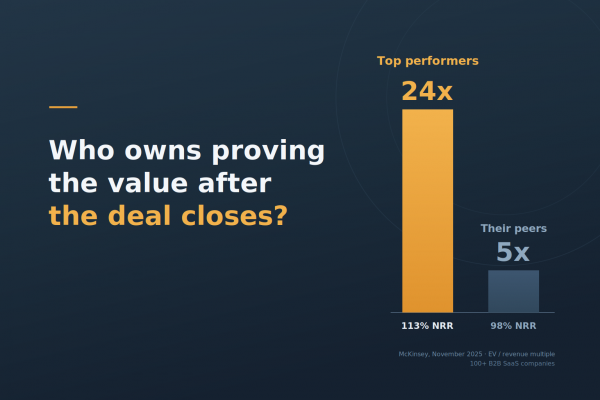
McKinsey’s November 2025 analysis of more than 100 B2B SaaS companies found that firms in the top quartile of valuation multiples trade at a median 24 times revenue, against 5 times for the bottom quartile. The retention split between those two groups: 113 percent net revenue retention versus 98 percent.
The same research isolates the practice that drives it. Companies offering the most sophisticated value realization and adoption journeys post net revenue retention roughly seven percentage points higher than peers running only basic practices. Only 18 percent of the executives surveyed were operating at that level.
Eighty-two percent of the market is leaving that on the table. Which is either a warning or an opening, depending on how fast you move.
Move 1: Build the Shared Value Plan before signature, not after
A Shared Value Plan is a jointly owned, written agreement on what value this investment will produce, how it will be measured, who owns each metric on both sides, and when it gets reviewed. It is built during the sales cycle out of the business case you already made, not reconstructed six months later when someone asks whether the deal worked.
Four things it has to contain:
- A dated, agreed baseline. Current performance, measured and signed off by the customer. No baseline, no proof. This is the single most skipped step and the single most expensive one to skip.
- A short list of value drivers. Three to five outcome metrics tied to the objectives the buying group actually cares about.
- A measurement method. Where each number comes from, who pulls it, and how often. Specificity here is what separates a value plan from a value aspiration.
- Named owners and a cadence. On both sides. A plan with only your names on it is a marketing document.
Here is the uncomfortable test: if your business case cannot survive being converted into a measurement plan, it was never a business case. It was a persuasion artifact.
The upside arrives earlier than most teams expect. Offering to be measured is itself a differentiator, because very few of your competitors will sign up for it.
Move 2: Wire product telemetry to realized value, not to activity
Most telemetry answers one question: is the customer using the product. The Shared Value Plan asks a different one: is the customer measurably better off, and by how much. Same data warehouse, different data model.
The discipline is mapping every value driver to two layers. A leading indicator you can see in your own telemetry, such as adoption depth, high value feature usage, or time to first productive use. And a lagging business outcome that lives in the customer’s systems, such as cycle time, cost per transaction, win rate, or revenue per rep. Telemetry proves the leading layer. Only the customer can confirm the lagging layer. You need both, and you need to know which is which.
McKinsey is blunt about why this stalls: modeling efforts get stuck on competing priorities, too many analytical tools, and missing data or telemetry. Their recommendation is worth adopting literally. Do not build the elaborate, business-rules-heavy model. Build a minimum viable early warning backbone focused on the use cases that matter most: adoption, retention, and cross sell.
One more thing about telemetry that leaders underweight. It will sometimes tell you the value is not landing. That is the feature, not the bug. Early bad news is a save. Late bad news is a churn event with a business case attached to it.
Move 3: Orchestrate it, because today nobody owns it
McKinsey names the structural problem without hedging: responsibility for the components of net revenue retention typically sits with different leaders, with discounting under pricing, retention under customer success, and expansion under sales. There is rarely one owner.
Value is fragmented worse than that. The business case sits in a seller’s spreadsheet. Adoption data sits in product. Outcome data sits with the customer. The renewal conversation sits with customer success. Four systems, four owners, zero continuity.
Orchestration comes down to three decisions:
- One system of record. The Shared Value Plan becomes a structured object in CRM with fields, owners, and dates, not a deck attached to an opportunity. If value is not a data object, RevOps cannot report on it, and if RevOps cannot report on it, it does not exist.
- One cadence. Value reviews replace status QBRs. Baseline, what we delivered against it, what comes next. Same three-part structure every time, in every account.
- Owners with incentives attached. McKinsey found that performance management and value reporting are themselves significant drivers, worth 15 and 13 percentage points of net revenue retention respectively for best-in-class practitioners, and that fewer than 20 percent of companies are best in class at both. Put non-financial value metrics such as time to first value into account team incentives and the behavior follows.
RevOps is the natural orchestrator here, but only if the CRO makes value a reported number rather than an enablement theme.
How to accelerate, and how to be sure you get it right
You do not need a transformation program. You need one segment and ninety days.
- Days 1 to 30. Pick a single segment or product line. Instrument the value story you are already selling. Define three to five outcome metrics, the baseline method, and the data source behind each one. Stop when a skeptical CFO could follow the arithmetic.
- Days 30 to 60. Pilot the Shared Value Plan in live deals. Track its effect on cycle time and win rate, because that is what buys you the mandate to expand it. In parallel, stand up the plan as a CRM object with owners and review dates.
- Days 60 to 90. Run realized value assessments on ten existing accounts. Compare what was promised to what actually happened. That gap is simultaneously your improvement roadmap, your expansion pipeline, and the beginning of a proof library you will use in every deal from here forward.
Three ways this goes wrong, all avoidable:
- Metric sprawl. Five drivers you can actually measure beat twenty you have to estimate. Estimated value is the fastest way to lose a numbers-literate buyer.
- Marketing-grade numbers. If a figure will not survive the customer’s finance team, cut it before they do.
- Treating it as a tooling project. Platforms make value work scalable. They do not make it rigorous. The capability sits with people: the analytical rigor to build the model, the empathy to know which outcomes matter to which stakeholder, and the coaching to make it a habit rather than an event.
The compounding asset
Realized value is the only proof that compounds. Every assessment you complete becomes the proof point for the next deal, the benchmark for the next business case, and the reason the next renewal is a formality instead of a negotiation.
The organizations building that library right now will spend next year selling with evidence. Everyone else will still be selling with claims, to buyers who have already told us, in the research, exactly how little patience they have left for the difference.
Let’s discuss your realized value program and how the Shared Value Plan + can help: Click here to schedule a consultation with us.
Sources:
71 percent of purchases become high quality, low regret deals when buyers apply all four value-based buying practices, versus 3 percent when they apply none. The fourth practice is continuous value assessment after purchase. Gartner, Value-Based Buying From Start to Finish (Hank Barnes), via Genius Drive analysis, May 2025. https://geniusdrive.com/gartner-the-rise-of-value-based-buyers/
Eight in ten B2B decision makers will actively look for a new vendor if performance guarantees are not offered. McKinsey B2B Pulse, cited November 2025. https://www.mckinsey.com/industries/technology-media-and-telecommunications/our-insights/the-net-revenue-retention-advantage-driving-success-in-b2b-tech
Top-quartile-valued B2B SaaS companies trade at a median 24x EV/revenue against 5x for the bottom quartile, with net revenue retention of 113 percent versus 98 percent. Based on more than 100 B2B SaaS companies, Q1 2019 through Q4 2024. McKinsey, November 2025. https://www.mckinsey.com/industries/technology-media-and-telecommunications/our-insights/the-net-revenue-retention-advantage-driving-success-in-b2b-tech
Companies with the most sophisticated value realization and adoption journeys achieve roughly 7 percentage points higher net revenue retention than peers with basic practices, and only 18 percent of surveyed executives operate at that level. Survey of more than 100 commercial, revenue, sales, and customer success leaders across 98 US B2B SaaS companies. McKinsey, November 2025. https://www.mckinsey.com/industries/technology-media-and-telecommunications/our-insights/the-net-revenue-retention-advantage-driving-success-in-b2b-tech
Best-in-class performance management and value reporting practices deliver 15 and 13 percentage points higher net revenue retention respectively, yet fewer than 20 percent of companies are best in class at both. McKinsey, November 2025. https://www.mckinsey.com/industries/technology-media-and-telecommunications/our-insights/the-net-revenue-retention-advantage-driving-success-in-b2b-tech
Responsibility for net revenue retention components typically sits with different leaders: discounting under pricing, retention under customer success, expansion under sales. Succeeding requires CEO and CFO sponsorship, a unified roadmap, and named owners per driver. McKinsey, November 2025. https://www.mckinsey.com/industries/technology-media-and-telecommunications/our-insights/the-net-revenue-retention-advantage-driving-success-in-b2b-tech