
Leads are harder to win than ever, and more pitching is not the fix. Buyers are skeptical of vendor claims, research on their own, and increasingly default to doing nothing. The organizations breaking through have stopped pitching products and started diagnosing problems.
Interactive capability and maturity assessments are the most scalable way to make that shift. Done well, a single diagnostic generates qualified demand, arms sellers for consultative conversations, and gives customer success a structured way to prove progress and expand. Done poorly, it is just a gated form with a quiz attached.
Why Now: Buyers Have Stopped Listening to Pitches
The buyer has gone self-service, and generic outreach is now a liability. Three findings should change how every revenue leader thinks about engagement:
- 67% of B2B buyers prefer a rep-free experience, and 45% used AI during a recent purchase (Gartner, March 2026).
- 73% of B2B buyers actively avoid suppliers who send irrelevant outreach (Gartner, June 2025).
- Confident buyers are twice as likely to report a high-quality deal. Gartner calls the goal “value clarity”: understanding how a solution improves outcomes in the buyer’s own role and context (Gartner, March 2026).
The implication is uncomfortable. Static collateral and product pitches no longer carry influence in the moments that matter. Buyers want to self-educate, but they still want help answering the hardest question: what does this mean for us? A well-built assessment answers exactly that, on the buyer’s terms, without a rep in the room.
One Diagnostic, Three Jobs Across the Lifecycle
The same assessment model can power marketing, sales and customer success. Each team uses it differently, but all three move from telling to diagnosing.
| Stage | Who uses it | The job it does | The outcome |
|---|---|---|---|
| Pre-sale self-service | Marketing, on the website | Lets buyers self-diagnose and benchmark, on their own time | Differentiated, value-first lead generation |
| Active selling | SDRs, BDRs and sellers | Replaces the discovery interrogation with a structured, peer-benchmarked diagnostic | Consultative conversations, better prioritization, fewer “do nothing” outcomes |
| Post-sale | Customer success | Measures progress against the baseline and maps the next level | A shared health metric, a dynamic roadmap, and organic up-sell, cross-sell and practice expansion |
Pre-sale, it earns the right to engage. Instead of asking for a meeting, you offer insight a buyer cannot get anywhere else: where they stand versus peers, and what it is costing them.
In active selling, it prioritizes and inspires change. Not all opportunities are equal. The diagnostic surfaces who needs help most and who is best suited to your solution. Peer leader comparisons create the urgency that moves a buyer from “do nothing” to “deal.”
Post-sale, it keeps the relationship consultative. Customer success and the customer reassess together, track health over time, and co-build a roadmap. Expansion becomes the logical next step on a plan the customer helped write, not a pitch.
The Hidden Asset: A Market Intelligence Base
Every completed assessment adds to a proprietary dataset of where prospects and customers actually stand. Over time, that becomes one of the most valuable assets a go-to-market team owns.
- Peer benchmarks that sharpen with every response, making each new report more credible.
- Segmentation and targeting: which industries, roles or company sizes are furthest behind, and where your solution fits best.
- Customer progress tracking: how far the installed base has advanced, and who is stalling.
- Original thought leadership: benchmark reports, industry briefs and custom marketing pieces built on your own data, not recycled third-party stats.
Why Most Assessments Fail, and the Fix
Most assessments are lead-capture forms in disguise, and buyers can tell. The same six mistakes show up again and again.
| What kills an assessment | What works instead |
|---|---|
| Gated up front: contact details before any value | Deliver value first, with intermediate scoring and a preview of results before asking for contact information |
| Page after page of questions, often one per page | As few pages as possible, in a clean, simplified interface |
| Vague questions with no guidance | Clear descriptions of the key characteristics of each maturity level, on every element |
| Results that underwhelm: a score and a sales pitch | Rich, specific online results and advice the buyer can act on |
| No peer context | Aggregate peer analysis that leverages data already collected |
| Nothing to share internally | A polished report artifact the champion can circulate to the buying group and economic buyers |
What a High-Value Results Experience Delivers
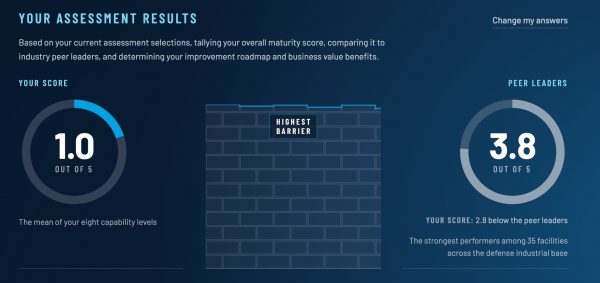
The results page is where an assessment earns trust or loses it. Ours are built to answer the eight questions every executive actually asks:
- Where are we? Overall and dimension-level maturity scores.
- Where are peer leaders? Benchmarks against top performers, not just averages.
- Where are we on the curve? Position on the maturity model, from lagging to leading.
- Where are we strong? Credit for what is working, which builds credibility.
- Where must we improve? The specific gaps that matter most.
- What is the status quo costing us? The quantified cost of inaction and the opportunities being lost.
- What should we do next? Prioritized, practical next steps.
- What is the value of moving up a level? The business case for change, in the buyer’s own numbers.
See It in Action
Three recent builds show the range, from our own go-to-market to highly specialized markets. Each takes five to six minutes and delivers value before asking for anything.
| Assessment | What it measures | Standout value delivered |
|---|---|---|
| Value-Led Growth Maturity (Genius Drive) | Progress from product-centric to value-led growth across Value Communication, Quantification and Activation | Which practices drive the biggest impact, where you lead or lag, and what to prioritize next |
| Operational Integration Readiness (Mass Group) | Secure manufacturing readiness across eight operational integration capabilities | Surfaces integration gaps before an audit, milestone or scale-up exposes them, and quantifies the value of advancing |
| Family Office Operational Excellence Index (Eleven) | Maturity across Property, Financial and Family operations | Pinpoints the one capability constraining each area, prices the gap per person, and shows what it takes to move up a level |
Try them:
- Value-Led Growth Maturity: https://geniusdrive.com/value-led-growth-maturity-assessment/
- Mass Group: https://geniusdrive.com/secure-manufacturing-operational-integration-readiness-assessment/
- Eleven: https://geniusdrive.com/eleven-family-office-operational-excellence-assessment/
How We Build Them
Wherever you are starting from, we take you to a deployed, high-value diagnostic:
- From scratch: we develop the ideas, dimensions and maturity model with you.
- From an existing framework: we validate and elevate your model, adding the value quantification and peer benchmarking that make results compelling.
- End to end: a great user experience, a compelling report, and a built and deployed tool ready for marketing, sales and customer success.
The question is no longer whether your buyers will self-diagnose. It is whether they will do it with your framework or someone else’s. Stop pitching. Start diagnosing.
Let’s talk about the assessment your market is waiting for: https://geniusdrive.com/contact-us/
Sources
- Gartner, “Gartner Sales Survey Finds 67% of B2B Buyers Prefer a Rep-Free Experience,” March 9, 2026: https://www.gartner.com/en/newsroom/press-releases/2026-03-09-gartner-sales-survey-finds-67-percent-of-b2b-buyers-prefer-a-rep-free-experience
- Gartner, “Gartner Sales Survey Finds 61% of B2B Buyers Prefer a Rep-Free Buying Experience,” June 25, 2025: https://gartner.com/en/newsroom/press-releases/2025-06-25-gartner-sales-survey-finds-61-percent-of-b2b-buyers-prefer-a-rep-free-buying-experience