
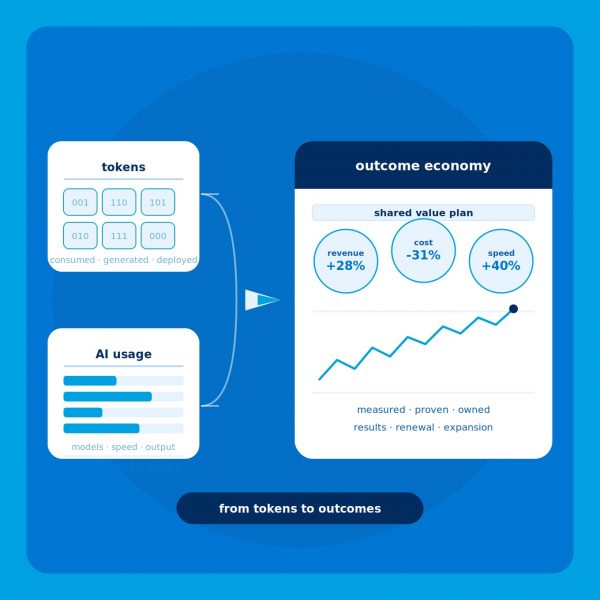
Salesforce just introduced something called Agentic Work Units, or AWUs. On the surface, it looks like a new billing metric. But if you read it as a market signal, it’s much more significant than that.
We are officially entering the Outcome Economy for AI.
Burning Tokens, Missing Value
For the past year, the dominant conversation in enterprise AI has been driven by activity. Tokens consumed. Models deployed. Code generated. Speed of output. These are the metrics that dominated investor decks, vendor dashboards, and executive briefings throughout 2024 and into 2025.
Here is the uncomfortable truth: none of those metrics actually prove value.
You can burn billions of tokens and not move a single business KPI. You can run dozens of AI experiments and still struggle to answer the question every CFO is now asking: Where is the return?
Salesforce’s AWU concept is a direct response to that question. It attempts to translate AI activity into something more meaningful: actual work completed, outcomes achieved, impact delivered. That’s directionally right. And it reflects a growing realization across the market.
AI adoption without measurable outcomes is just expensive experimentation.
Three Pressures Forcing the Shift
This isn’t a philosophical evolution. It’s being driven by real business pressure.
1. The AI ROI Problem
Early AI investments were largely driven by curiosity and competitive fear. In 2023 and 2024, the fear of being left behind was enough to justify the budget line. That era is closing.
Executives are now evaluating AI like any other capital investment, through the lens of financial impact. And many organizations are struggling to make the case. According to McKinsey’s 2024 State of AI report, while AI adoption has nearly doubled since 2023, fewer than a quarter of respondents say their organizations have meaningfully quantified the financial value of their AI investments. The curiosity budget is drying up. The accountability budget is opening.
2. Rising Customer Expectations
Buyers no longer care how much AI you are using. They care what it does for them.
Faster resolutions. Better recommendations. Increased revenue. Lower costs. The bar has shifted from innovation to outcomes, and it has shifted quickly. A 2024 Salesforce State of the Connected Customer report found that 65% of customers expect companies to adapt to their changing needs and preferences. Generic AI activity metrics tell that story poorly. Outcome metrics tell it directly.
3. The Collapse of Vanity Metrics
Token usage is quickly becoming the AI equivalent of page views or unique visitors. Easy to measure. Appealing in a board slide. Disconnected from value creation.
The industry is waking up to a basic principle that performance marketers learned a decade ago: activity is not impact. Impressions are not revenue. Tokens are not outcomes.
AWUs Confirm What the Outcome Economy Has Been Telling Us
AWUs are not just a new billing unit. They are Salesforce acknowledging something the broader market has been building toward for years: outcomes are the new currency of growth.
This aligns directly with what Deloitte’s 2026 Software Industry Outlook identified as a defining trend: AI-native competitors are no longer competing on features. They are competing on results. Eliminating manual processes. Accelerating decisions. Reducing operational costs. When the market’s newest and most aggressive entrants lead with outcomes, every incumbent has to follow, or lose the executive conversation before it starts.
Gartner projected that by 2025, outcome-based pricing would be embedded in 40% of new enterprise software deployments, nearly triple prior levels. McKinsey found that organizations adopting results-driven pricing models reported 28% higher satisfaction with their software investments.
The Outcome Economy is not a future state. It is the current state, and AWUs are one of the clearest signals yet that the largest vendors are catching up to it.
Salesforce recognizes this. Other providers need to as well. And critically, so do the GTM leaders on both sides of the deal.
The Real Shift: From Metrics to Shared Accountability
Acknowledging the Outcome Economy is the easy part. Operating in it requires something more structurally different.
The traditional business case was designed for a different era. It was built pre-sale, anchored to a moment in time, and optimized for one purpose: closing the deal. Once the contract was signed, it quietly retired to a CRM attachment, never revisited, never operationalized, never used to guide adoption, renewal, or expansion. It was a promise made once, to no one in particular, with no mechanism for follow-through.
That model is no longer viable. Buyers are now asking the same question at renewal that they asked at procurement: What did we actually get? And in an AI-first enterprise, that question carries a harder edge: Can we do this ourselves with AI instead?
Unproven value gets replaced. Either by internal tooling, alternative platforms, or nothing at all.
What the moment demands is not a better metric. It is a different operating model: the Shared Value Plan.
A Shared Value Plan is a living, co-owned agreement between vendor and customer that defines what outcomes matter, how they will be measured, and what the ongoing rhythm of proof looks like across the entire customer lifecycle. It does not disappear at signature. It compounds. Sales uses it to anchor the value hypothesis. Product supplies the telemetry to make value observable. Customer Success operationalizes it through outcome-driven reviews. Leadership reinforces it as the commercial operating system.
This is the infrastructure that makes outcome-based AI investments defensible, not just at close, but at renewal, expansion, and every executive review in between.
What This Means for GTM and Value Leaders
The Outcome Economy is not a trend to monitor. It is an operating reality to build for.
That requires a deliberate shift across every commercial function:
From | To |
|---|---|
Measuring usage | Measuring outcomes |
Tracking activity | Demonstrating financial value |
One-time business case | Living Shared Value Plan |
AI adoption | Value realization |
For GTM and value leaders specifically, this means three things:
- First, align on outcome metrics with the customer before deployment, not after, because baselines established retroactively are baselines no one trusts.
- Second, build the Shared Value Plan as a cross-functional asset, owned by sales, customer success, finance, and the customer together, because value siloed in one function does not survive renewal scrutiny.
- Third, treat value realization as an ongoing capability (and instrumented telemetry within the solution), not a post-sale justification exercise, because in the Outcome Economy, the business case actually becomes the product.
Think about that for a moment. In a world where AI can replicate features and commoditize capabilities faster than any prior technology cycle, the ability to consistently quantify, communicate, and prove outcomes may become the most durable competitive advantage in enterprise software.
The Bottom Line
Salesforce’s AWUs are an important signal. They confirm what many GTM and value leaders already know: the market is moving from AI hype to AI accountability.
Salesforce recognizes it. Deloitte’s research confirms it. The data from McKinsey, Gartner, and every tightening renewal conversation reinforces it. The Outcome Economy is not approaching. It is here.
The winners in this next phase will not be the companies that use the most AI. They will be the ones that build the operating infrastructure to prove what it delivers, through shared accountability, living value plans, and outcome metrics that both sides own and trust.
The business case is dead. The Shared Value Plan is the future.
And the question every AI initiative needs to answer right now is no longer what are we building? It is: Can we prove it is delivering business outcomes?
Let’s discuss the Outcome Economy, AWUs and the significant GTM implications for you and your company: Click here to schedule a consultation with us.
Source: https://www.salesforce.com/news/stories/agentic-work-units/