
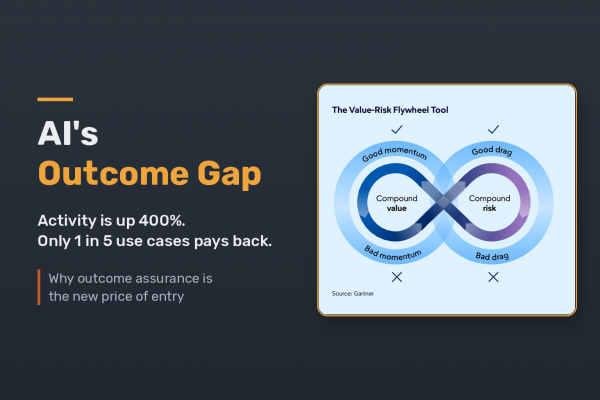
AI activity is exploding. AI outcomes are not. That was the uncomfortable message at the center of this year’s Gartner IT Symposium/Xpo keynote, and it should be a wake-up call for every CIO, CFO and the vendors selling to them.
In just one year, the average organization grew its number of AI use cases by more than 400%. Yet value is creeping up incrementally while risk compounds. Gartner’s prescription is a Value-Risk Flywheel and an “AI Central Bank.” Ours is simpler to say and harder to do: stop managing AI activity and start assuring AI outcomes.
The outcome gap, in three numbers
Gartner’s data shows a market confusing motion with progress:
- 58% of functional leaders report positive value from their 2025 AI initiatives.
- Yet only 1 in 5 AI use cases actually delivers a positive return.
- And 86% of CIOs say AI risk is growing faster than AI value, 4x faster on average.
Read those together. Most leaders feel AI is working, while 80% of use cases fail to pay back. That gap between perceived value and proven value is the real risk. It is where budgets get cut, renewals get questioned and trust erodes.
Gartner calls the result “bad momentum”: more projects, more complexity and more effort, with little impact. We call it the outcome gap.
The problem isn’t AI. It’s the missing outcome system.
The instinct is to blame the technology: immature models, hallucinations, data quality. But a 1-in-5 success rate is not a model problem. It is a management problem.
Most AI initiatives launch with a business case built to win approval, not to be measured. No agreed baseline. No instrumented KPIs. No owner accountable for realized value between kickoff and renewal. So nobody can tell the good use cases from the bad ones, and the portfolio grows by 400% instead of concentrating on what works.
Gartner’s own Symposium agenda makes the point bluntly: IT value conversations tend to collapse because the business never takes ownership of outcomes. Their remedy is shifting from proving value to enforcing ownership, through decision rights, portfolio-level value measures and renewal-gate accountability.
That is why outcome assurance matters more than AI strategy right now. Outcome assurance is the discipline of defining, baselining, tracking and proving value continuously, from the business case through realization. Without it, you cannot build good momentum, because you cannot see which momentum is good.
Five moves to turn AI activity into assured outcomes
Gartner’s six takeaways map closely to what we’ve argued about value realization. Here is how to put them to work.
- Replace the business case with a Shared Value Plan. Gartner urges leaders to consciously choose the value-risk balance that fits their objectives. That choice starts before investment: a jointly owned plan with agreed outcomes, baselines and success metrics, not a one-time ROI slide built to win approval.
- Instrument for value, not just activity. Gartner’s “good drag” includes stronger evidence trails and AI activity tracking. Extend that to outcomes. If a use case can’t capture the KPIs needed to quantify its impact, it can’t prove its worth, and it can’t be scaled with confidence.
- Make value economics part of governance. The AI Central Bank puts economics alongside accountability, technology and intelligence on one control plane. Smart move. Value should be governed like spend: tracked, reported and reallocated toward the use cases that compound.
- Run Value Reviews, not just status reviews. Good momentum comes from “scaling proven successes.” You can only scale what you’ve proven. Regular Value Reviews that quantify realized outcomes, separate from project updates and QBRs, are how you separate the 1 in 5 winners from the rest and redirect investment.
- Put people at the center of value, not just safety. Gartner casts people as first responders and the last line of defense. They are also the source of value: work redesign, adoption and behavior change are where AI outcomes are won or lost. Fund the change, not just the tool.
What this means for vendors: outcome assurance is the price of entry
If you sell AI-powered solutions, read the Gartner keynote as your buyer’s new operating manual. CIOs are being told to cut bad momentum, add good drag and govern AI economics centrally. Every one of those actions lands on your renewal.
The vendors who win will be the ones who answer the value question on the buyer’s behalf:
- Pre-sale: a transparent, customer-specific value model with baselines and agreed outcomes.
- Post-sale: instrumented KPIs and a disciplined handoff, so the value promised is the value tracked.
- Ongoing: Value Reviews that prove realized outcomes well before renewal, and give your champion the evidence to defend you.
This is especially urgent as pricing shifts toward usage and outcomes. When the meter runs on results, value that isn’t measured becomes a dispute waiting to happen.
Value realization used to be a differentiator. In a market where only 1 in 5 AI use cases pays back, it is the price of entry.
Pricing has to follow the outcome
Pricing is where the outcome gap turns into a revenue problem. Gartner estimates up to $234 billion of enterprise application spending is exposed to agentic AI between now and 2030, roughly 20% of enterprise SaaS spending, because this breaks the link between user growth and revenue growth for many enterprise software vendors. It also expects at least 40% of enterprise SaaS spend to shift toward usage-, agent-, or outcome-based pricing by 2030. Gartner Says $234 Billion in Enterprise Application Software Spend Is at Risk from Agentic AI +2
Four models now compete for the AI era, and each places a different demand on value:
- Per-seat (legacy). Priced on humans in the tool, it erodes as AI replaces the seats. A discount won’t fix it. Re-anchor the conversation on the work delivered before the renewal does it for you.
- Consumption (common). Priced on tokens, calls or usage, it aligns to load, not value. Without a value view, a rising meter reads as a cost spike, not a return, and it becomes the first line item a CFO questions.
- Outcome-based (emerging). Priced on the business result delivered, this is the direction of travel. It only works with an agreed baseline, an instrumented KPI and a shared definition of success. Without those, every invoice becomes a negotiation.
- Hybrid outcome plus consumption (advanced). A base fee anchored to outcomes, with variable pricing on scaled usage. It gives the CFO predictability and the vendor upside, tied to value both sides can see.
The trend line is clear: the closer pricing sits to the customer’s business result, the more defensible it becomes. But pricing is only as defensible as the measurement behind it. Outcome-based pricing without outcome assurance is just risk transfer.
Three moves to reshape pricing around value:
- Price the unit of value, not the unit of access. Define the value metric with the customer, such as resolutions completed, hours returned or audit evidence produced, rather than logins or tokens.
- Make the Shared Value Plan the pricing contract. The baseline, KPIs and measurement method agreed before purchase become the terms that outcome and hybrid pricing depend on.
- Let Value Reviews govern the meter. Review realized outcomes alongside usage before every renewal, tier change or expansion, so price and proof move together.
The Bottom-Line: Close the outcome gap
Gartner is right that AI value and risk now compound. The question is which one compounds faster in your organization, and in your customers’. Activity won’t answer it. Outcome assurance will.
Where does your value practice stand? Take the Value-Led Growth Assessment: https://vlg.geniusdrive.com
Want to talk through how to build outcome assurance into your business cases, handoffs, pricing and Value Reviews? Book a one-on-one: https://calendly.com/tpisello-gd/one-on-one
Sources
- Gartner, “Balance Compounding AI Value and Risk: 6 takeaways from the Gartner IT Symposium/Xpo keynote,” October 2026 (CM_GTS_5419150)
- Gartner, “Gartner Says AI Risk is Rising Faster Than AI Value,” October 19, 2026: https://www.gartner.com/en/newsroom/press-releases/2026-10-19-gartner-it-symposium-xpo-keynote-release-2026
- Gartner, “AI Success Depends on Managing Risk, Not Just Creating Value”: https://www.gartner.com/en/articles/it-symposium-keynote-ai-value-risk-flywheel
- Gartner IT Symposium/Xpo 2026, session “From Chaos to Control: How to Manage your Growing AI Costs”: https://www.gartner.com/en/conferences/na/symposium-us/sessions
- Gartner, “Gartner Says $234 Billion in Enterprise Application Software Spend Is at Risk from Agentic AI,” July 1, 2026: https://www.gartner.com/en/newsroom/press-releases/2026-07-01-gartner-says-us-dollars-234-billion-in-enterprise-application-software-spend-is-at-risk-from-agentic-artificial-intelligence
- Deloitte, TMT Predictions 2026, citing Gartner’s 2030 pricing forecast: https://www.deloitte.com/us/en/insights/industry/technology/technology-media-and-telecom-predictions/2026/saas-ai-agents.html